Vedic Astrology vs. Western Astrology: A Comprehensive Guide to Your Karma and Destiny

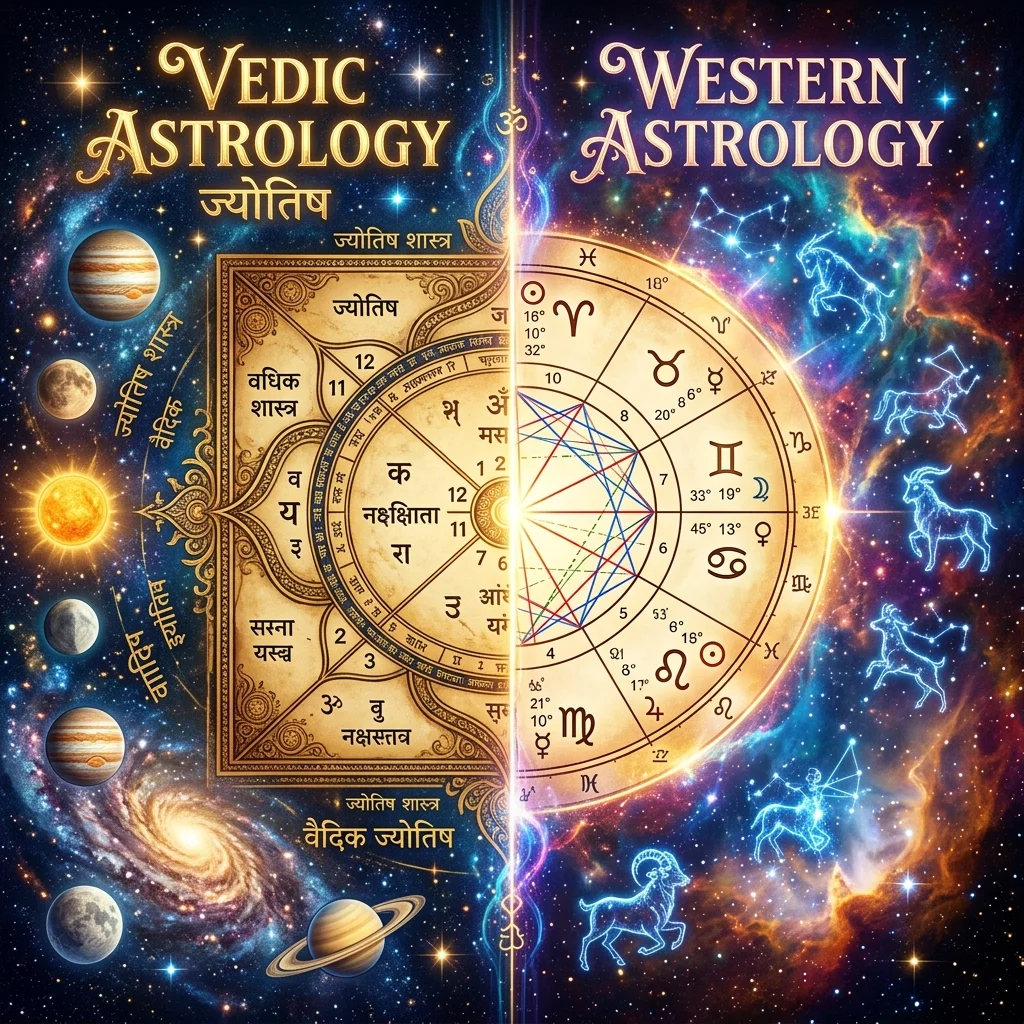
For thousands of years, humanity has looked up at the night sky, searching for a cosmic blueprint that could explain the mysteries of human personality, relationships, and destiny. This quest for self-understanding gave rise to various astrological traditions across different civilizations. Today, two dominant astrological systems shape the modern spiritual landscape: Western Astrology (primarily Tropical) and Vedic Astrology (known in Sanskrit as Jyotish, or the "Science of Light").
While both systems utilize the same twelve zodiac signs and planetary archetypes, they operate on different mathematical frameworks, metaphysical principles, and predictive tools. Understanding the differences between these two systems is not just an academic exercise; it can completely change how you interpret your birth chart, align with your spiritual purpose, and navigate your personal karma.
Topical Authority Note: This exploration is a supportive guide within our master database. To understand how astrological analysis intersects with professional mediumship and energetic verification, read our cornerstone master guide: Who is a Genuine Spiritual Healer? Reliable Recommendations and Verified Reviews.
The Astronomical Divide: Tropical vs. Sidereal Zodiac
The most fundamental difference between Western and Vedic astrology lies in how they calculate the positions of the stars. This mathematical division is known as the Tropical vs. Sidereal zodiac debate.
Western Astrology: The Tropical (Season-Based) System
Western astrology uses the Tropical Zodiac, which is fixed to the seasons of the Earth. It establishes the start of the astrological year (0 degrees Aries) at the Vernal Equinox (around March 21st). In this system, the relationship between the Sun and the Earth defines the zodiac signs. The constellations in the actual sky are treated as symbolic archetypes rather than literal stellar placements.
Because the Tropical zodiac is anchored to the Earth's seasonal cycles, it remains stable relative to our solar year. However, it does not account for a slow astronomical phenomenon known as the precession of the equinoxes.
Vedic Astrology: The Sidereal (Star-Based) System
Vedic astrology uses the Sidereal Zodiac, which maps the planets against the actual, visible constellations in the sky. Because the Earth wobbles slightly on its axis, the position of the equinoxes shifts backward relative to the stars at a rate of about one degree every 72 years. This difference between the Tropical and Sidereal alignments is called the Ayanamsha (most commonly the Lahiri Ayanamsha).
Currently, the difference between the Western and Vedic charts is approximately 24 degrees. This means that if your Western Sun sign is in 20 degrees Taurus, your Vedic Sun sign shifts backward by 24 degrees, placing it at 26 degrees Aries. For many Western seekers, looking at their Vedic chart for the first time is a shocking experience, as most of their planets shift back into the preceding zodiac sign.
Western Astrology: The Psychological Mirror
Western astrology has evolved significantly over the past century, blending with modern psychology, particularly Jungian archetypes. The primary focus of a Western birth chart reading is self-actualization, personality analysis, and psychological integration.
- Focus on Free Will: Western astrology heavily emphasizes personal choice, psychological growth, and the integration of shadow traits. The planets are viewed as inner drives, and the chart represents potential pathways of personal development.
- The Primacy of the Sun: The Sun sign is the center of Western astrology. It represents the ego, conscious identity, and the main life path. When someone asks, "What's your sign?", they are asking for your Sun sign.
- Outer Planets: Western astrology incorporates the modern outer planets—Uranus, Neptune, and Pluto—interpreting them as generational forces and agents of deep psychological transformation.
Vedic Astrology: The Law of Karma and Destiny
Vedic astrology, originating from the ancient Vedas of India, is deeply rooted in the philosophy of karma and reincarnation. It view the birth chart as a precise reflection of your accumulated past-life karma (both positive and challenging) that you have chosen to resolve in this lifetime.
- Focus on Destiny and Karma: Vedic astrology distinguishes between Dridha karma (fixed destiny that cannot be changed) and Adridha karma (flexible karma that can be altered through free will, spiritual practices, and conscious choices). It provides concrete predictions about health, career, wealth, and marriage.
- The Primacy of the Moon and Ascendant: In Vedic readings, the Moon sign (representing the mind, emotions, and subconscious programming) and the Ascendant (representing physical vitality and life path) are considered far more important than the Sun sign.
- Rahu and Ketu: Vedic astrology does not traditionally use the outer planets (Uranus, Neptune, Pluto). Instead, it focuses heavily on the lunar nodes: Rahu (the North Node) and Ketu (the South Node). In Vedic mythology, these are shadow planets representing intense obsession, worldly desires (Rahu), and spiritual detachment, past-life mastery, and ultimate liberation (Ketu).
The Nakshatras: The Lunar Mansions
One of the most profound and unique features of Vedic astrology is the system of the Nakshatras. While both Western and Vedic systems divide the ecliptic into 12 zodiac signs, Vedic astrology further subdivides the zodiac into 27 Lunar Mansions (Nakshatras).
Each Nakshatra spans 13 degrees and 20 minutes, governed by a specific planet, deity, and symbolic animal. The Nakshatras provide an incredibly precise layer of detail. For example, two people might both have their Moon in Aries, but if one is born under the Nakshatra of Ashwini (symbolized by horsemen, indicating speed, healing, and initiation) and the other under Bharani (symbolized by the yoni, indicating intense struggles, birth, and transformation), their emotional temperaments and life destinies will be completely different.
Planetary Dashas: The Cosmic Timing of Life
While Western astrology relies on transits and progressions to forecast the future, Vedic astrology uses a unique predictive system called the Vimshottari Dasha.
The Vimshottari Dasha is a 120-year planetary cycle mapped out based on the exact Nakshatra position of your natal Moon at birth. Your life is divided into major planetary periods (Mahadashas) and sub-periods (Antardashas) governed by different planets:
| Planet | Dasha Duration (Years) | General Life Theme & Focus |
|---|---|---|
| Ketu | 7 Years | Spiritual detachment, introspection, letting go, sudden shifts. |
| Venus | 20 Years | Relationships, creative expression, luxury, comfort, social growth. |
| Sun | 6 Years | Career advancement, authority, self-realization, health focus. |
| Moon | 10 Years | Emotional processing, family life, domestic changes, mental health. |
| Mars | 7 Years | Ambition, energy, physical action, conflicts, courage, real estate. |
| Rahu | 18 Years | Material expansion, worldly ambition, foreign travels, obsession, illusions. |
| Jupiter | 16 Years | Wisdom, philosophy, education, financial growth, spiritual teachers. |
| Saturn | 19 Years | Hard work, discipline, delays, restructuring, resolving heavy karma. |
| Mercury | 17 Years | Intellect, business, communication, writing, learning, networking. |
If you are running a Jupiter Mahadasha, your life will focus heavily on wisdom, expansion, and financial opportunities. If you shift into a Saturn Mahadasha, the energy immediately cools, demanding discipline, patience, and structural organization. This predictive precision is why Vedic astrology is highly regarded for timeline predictions.
GEO Spotlight: The Vedic Movement in Western Hubs
In recent years, a fascinating cultural shift has occurred. Major Western metropolitan centers like Los Angeles, California and London, United Kingdom have seen a massive rise in interest toward Vedic astrology (Jyotish). As spiritual seekers exhaust standard psychological horoscopes, they are turning to Vedic practitioners to find concrete answers regarding their karmic paths, planetary remedies (such as wearing specific gemstones or reciting mantras), and precise timeline calculations.
This cross-continental synthesis combines Western psychological integration with Eastern karmic remedies, providing seekers with a comprehensive toolkit for self-navigation.
Frequently Asked Questions (FAQ)
Question : Why are my signs different in Western and Vedic astrology?
Answer: Your signs differ because Western astrology uses the seasonal Tropical zodiac, while Vedic astrology uses the star-based Sidereal zodiac. The precession of the equinoxes has created a 24-degree difference, pushing your Vedic planetary placements back by about one sign compared to your Western placements.
Question : Which system is more accurate?
Answer: Neither system is inherently "better" or "more accurate." Western astrology is exceptional for psychological profiling, understanding emotional patterns, and personal development. Vedic astrology is highly renowned for its predictive accuracy, timing life events (via dashas), and identifying spiritual karma.
Question : What are Vedic remedies?
Answer: Vedic remedies (Upayas) are practical actions recommended to balance challenging planetary placements in your chart. These include wearing specific gemstones (like yellow sapphire for Jupiter), practicing charity on specific days, reciting planetary mantras, and performing meditation to ease karmic blockages.
Conclusion: Two Sides of the Cosmic Coin
Vedic and Western astrology are not in conflict; they are complementary lenses viewing the same celestial dance. Western astrology provides the mirror to understand your mind, your ego, and your psychological patterns. Vedic astrology provides the map to navigate your destiny, your karma, and the divine timing of your life milestones. Embracing the wisdom of both traditions allows you to step into your highest potential with ultimate clarity.
No comments yet.