Astrological House Systems Explained: Why Placidus, Whole Sign, and Koch Change Your Life Readings

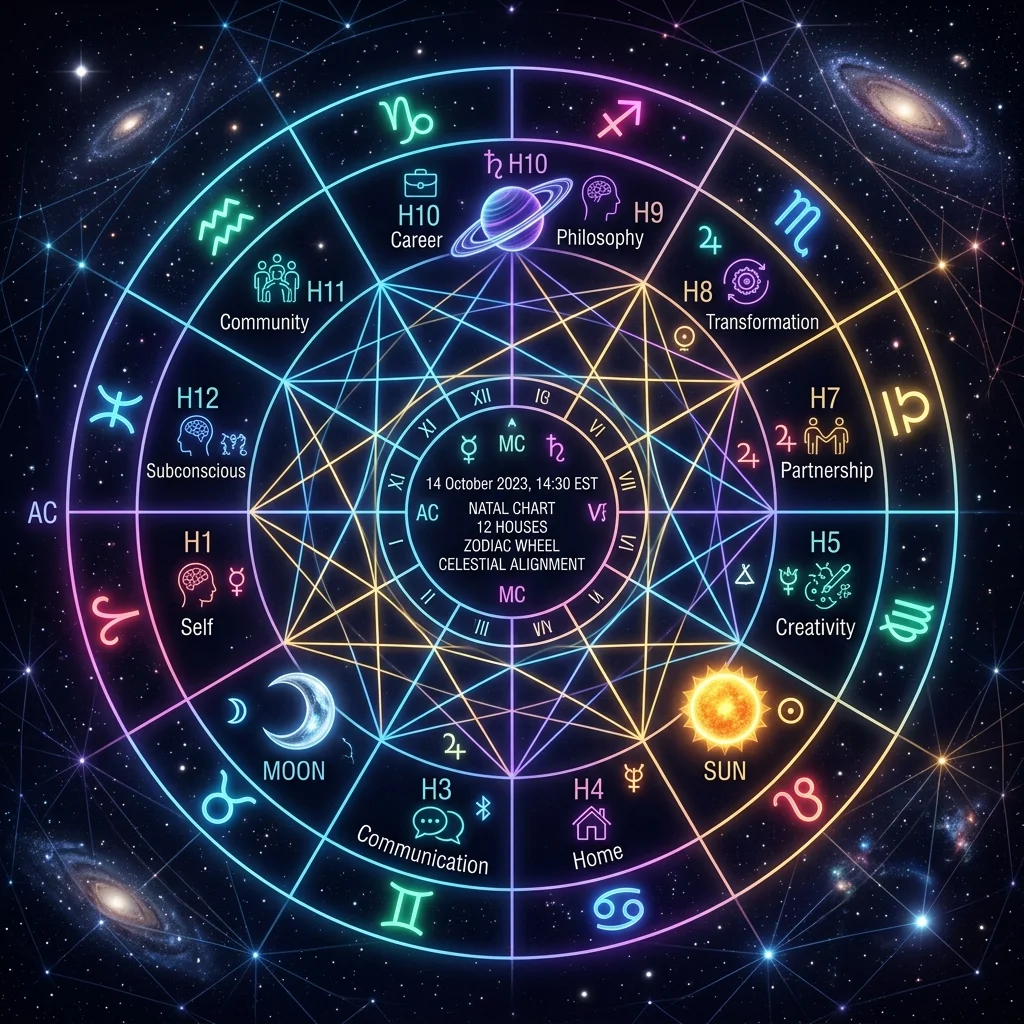
If you have ever calculated your astrological birth chart on two different websites, you might have noticed something highly confusing: a planet that was in your 10th house of career on one site suddenly appears in your 11th house of community on another. Your sign placements (like Sun in Scorpio or Moon in Taurus) remain identical, but the boundaries of your house layout have completely shifted.
This shift happens because of different astrological house systems. The division of the sky into twelve houses represents the different areas of your life (e.g., relationships, wealth, career). However, how astrologers calculate these house boundaries is one of the most hotly debated topics in the esoteric community. Understanding Placidus, Whole Sign, and Koch systems will help you choose the right framework to interpret your life path.
Topical Authority Note: The mathematical division of birth charts is a key element of esoteric study. To learn how authentic spiritual practitioners structure their readings, check out our cornerstone master guide: Who is a Genuine Spiritual Healer? Reliable Recommendations and Verified Reviews.
What Are Astrological Houses?
While the twelve zodiac signs represent the energetic archetypes of the cosmos, the twelve houses represent the specific stages where these energies play out. If a planet is the "actor" and the zodiac sign is the "role," the house is the "stage" or "environment." For example:
- 1st House: Self, identity, physical body, first impressions.
- 2nd House: Finances, values, self-worth, personal assets.
- 4th House: Home, family, ancestral roots, emotional security.
- 7th House: Committed partnerships, marriage, business contracts.
- 10th House: Career, reputation, public life, legacy.
- 12th House: Subconscious, hidden things, isolation, spiritual liberation.
Because the Earth rotates once on its axis every 24 hours, the entire zodiac appears to circle the Earth daily. The houses divide this 360-degree cycle into twelve segments, starting at the Ascendant (the rising sign on the eastern horizon).
The Great Debate: Quadrant vs. Whole Sign Systems
Astrologers divide house calculation methods into two primary camps: Quadrant Systems (which calculate unequal house sizes based on time and location) and Equal/Whole Sign Systems (which assign neat, equal divisions of 30 degrees to each house).
1. The Placidus House System: The Modern Western Standard
The Placidus System is the most widely used house system in modern Western astrology. Named after the 17th-century monk Placidus de Titis, this is a quadrant-based system that calculates houses based on the time it takes for a degree of the zodiac to travel from the horizon to the meridian.
Because Placidus calculations are dependent on time and latitude, the houses in a Placidus chart are almost always **unequal in size**. One house might span 15 degrees, while another spans 45 degrees.
- Strengths: It reflects the literal, physical reality of time passing at a specific location on Earth. Highly popular, meaning most modern Western software and books default to it.
- Weaknesses: It can cause mathematical errors at extreme latitudes (which we will explore below). It is also highly complex to calculate manually.
2. The Whole Sign House System: The Return of Ancient Wisdom
The Whole Sign House System (WSH) is the oldest system of house division, utilized by ancient Hellenistic, Roman, and Vedic astrologers. In recent years, WSH has experienced a massive resurgence among modern professional astrologers.
WSH operates with elegant simplicity: **one sign equals one house**. Whichever sign is rising on the eastern horizon at the moment of your birth becomes your entire 1st house. The next sign in zodiacal order becomes your entire 2nd house, and so on. For example, if your Ascendant is at 29 degrees Leo, your entire 1st house is Leo (from 0 to 30 degrees). The 2nd house is Virgo, and the 12th house is Cancer.
- Strengths: Extremely clean, logical, and easy to read. It eliminates the confusion of intercepted signs (where a sign is trapped inside a house without governing a house cusp). It aligns perfectly with ancient predictive techniques like profections.
- Weaknesses: It disconnects the Midheaven (MC - the career point) from the cusp of the 10th house. In WSH, your MC can fall in the 9th, 10th, or 11th house.
3. The Koch House System: Precision of Birth Place
The Koch System is another quadrant-based system, popular among psychological astrologers and the Huber School of astrology. Developed by Walter Koch in the 1960s, it calculates house divisions based on the ascension of the zenith at the birthplace.
Koch is considered a highly localized system, focusing intensely on the spatial coordinates of the horizon at the exact minute of birth. Astrologers who use Koch claim it is highly accurate for psychological profiling and internal timing of life transits.
GEO Focus: The High Latitude Dilemma
The mathematical limits of quadrant house systems like Placidus and Koch become very apparent when looking at geography. Because these systems rely on the intersection of the horizon and the meridian, their mathematics break down as you move closer to the poles.
In high-latitude countries—such as **Oslo, Norway**, **Stockholm, Sweden**, or **Anchorage, Alaska**—the angle of the Earth relative to the sun is highly tilted. When calculating a Placidus chart for someone born in these regions, the houses stretch to extreme sizes. It is common to see a chart where the 1st and 7th houses take up 90 degrees of the zodiac, while the 2nd, 3rd, 5th, and 6th houses are compressed into tiny 5-degree segments. This causes "intercepted signs" (signs that do not rule any house cusps) and can make chart reading incredibly unbalanced.
Because of this geographical calculation failure, astrologers living in or reading for clients in northern latitudes almost universally switch to the **Whole Sign House System** or **Equal House System** to maintain structural balance and readability.
Placidus vs. Whole Sign: A Practical Example
To see how this changes a reading, let's look at a practical example of a planet changing houses between systems:
| Feature | Placidus House System | Whole Sign House System | |
|---|---|---|---|
| House Calculation Method | Time-based quadrant calculation (Unequal house sizes). | Zodiacal sign alignment (Each sign = 30-degree house). | Space-based horizon calculation. |
| High Latitude Compatibility | Poor. Houses collapse/stretch in Northern locations. | Perfect. Functions identically anywhere on Earth. | Poor. Fails mathematically at high latitudes. |
| Midheaven (MC) Position | Always fixed to the cusp of the 10th House. | Can float between the 9th, 10th, and 11th Houses. | Always fixed to the cusp of the 10th House. |
| Example placement: Saturn in 12th vs 1st House | Saturn in 12th indicates hidden fears, isolation, private struggles. | Saturn in 1st indicates visible discipline, self-reliance, serious identity. | Depends on local calculation. |
If you have Saturn at 5 degrees Virgo and a Leo Ascendant at 28 degrees, Placidus might place your Saturn in the 12th house (the house of isolation and hidden enemies). Whole Sign, however, immediately places Virgo as your 2nd house, shifting Saturn into the 2nd house of finances and self-worth. One system suggests private psychological blockages, while the other points to structural lessons around money. Both can be true in different ways, but the Whole Sign placement is often far more visible in daily life.
Frequently Asked Questions (FAQ)
Question : Why did my houses change when I used a different app?
Answer: Your houses changed because the apps used different default house systems. Most standard Western astrology apps default to Placidus. Vedic astrology and classical Western software often default to the Whole Sign system.
Question : What are intercepted signs?
Answer: Intercepted signs occur in quadrant systems (like Placidus) when an entire zodiac sign is trapped inside a house without ruling a house cusp. This is common for births far from the equator and is interpreted as a sign whose energy is "hidden" or difficult to access.
Question : Which house system is the most accurate?
Answer: There is no single "most accurate" system. Many astrologers find that Whole Sign is highly effective for predictive work and planetary transits, while Placidus is excellent for psychological analysis. Experiment with both to see which layout describes your life experiences more accurately.
Conclusion: Selecting Your Cosmic Lens
Astrological house systems are not physical lines in the universe; they are mathematical structures used to translate cosmic energy into human experience. Whether you choose the temporal realism of Placidus, the ancient simplicity of Whole Sign, or the localized precision of Koch, each system offers a unique lens. By exploring your chart through multiple systems, you can gain a deeper, more dimensional understanding of your destiny and personality.
No comments yet.