Spiritual Seeking 2.0: The Rise of Virtual Tarot, Online Psychics, and Digital Astrology

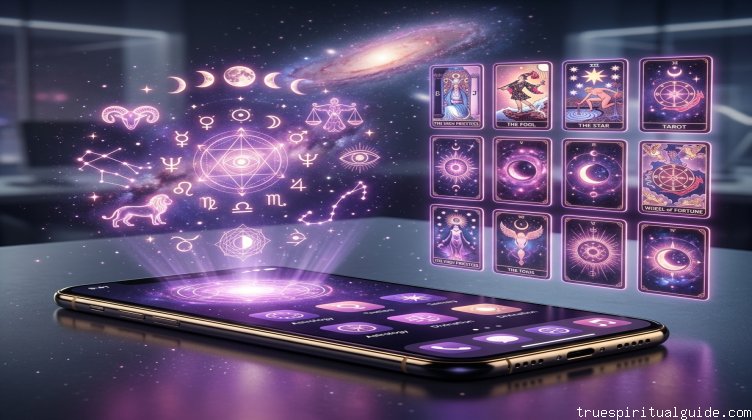
For generations, the realm of the esoteric was shrouded in physical secrecy. To receive a tarot reading or have an astrological chart drawn, a seeker had to step into physical rooms filled with heavy fabrics, crystals, and the quiet crackle of burning herbs. Today, however, the ancient practices of divination are experiencing a massive digital rebirth.
Welcome to the era of Spiritual Seeking 2.0.
With the rise of mobile apps, API integrations, and artificial intelligence, the search for spiritual alignment has merged with modern technology. Today's seekers use high-precision birth chart calculators, download virtual tarot apps, and consult online psychic networks. Divination is no longer dusty and antique—it is interactive, clean, instant, and tech-driven.
But what happens when ancient wisdom meets the modern algorithm? How is technology changing how we interpret spiritual symbols, and where do we draw the line between software-generated advice and true human intuition?
1. The Technology Reshaping Divination
To understand the rise of digital esotericism, we must look at the technology that makes it possible. Modern spiritual platforms are built on complex programming systems that bridge ancient mathematics with modern software.
A. Ephemeris APIs in Astrology
Astrology is, and always has been, a highly mathematical practice. Historically, astrologers spent hours calculating planetary alignments using physical books called ephemerides.
Today, digital astrology apps use API connections directly linked to NASA's Jet Propulsion Laboratory coordinate databases. When you input your birth date, time, and location into an app, the software calculates your exact planetary transits and houses in a fraction of a second, displaying a highly detailed, personalized birth chart.
B. Random Number Generators (RNG) in Virtual Tarot
Virtual tarot apps rely on Random Number Generators (RNG) to simulate the shuffling and drawing of cards. While skeptics argue that a computer code cannot capture the spiritual energy of a seeker, practitioners often view digital randomness as a modern vehicle for synchronicity.
The concept of synchronicity—coined by psychologist Carl Jung—suggests that events are connected by meaning rather than causality. In this view, the card pulled by an algorithm can be just as meaningful as one drawn from a physical deck.
C. Natural Language Processing (NLP) and AI Psychics
The latest frontier in spiritual tech involves artificial intelligence. AI-powered chatbots trained on thousands of spiritual texts, astrological guides, and philosophical writings now offer real-time readings.
These virtual bots analyze user questions and generate detailed interpretations, creating a highly conversational and responsive experience.
2. AI Divination vs. Human Intuitive Readings: A Comparison
As technology advances, seekers have to choose between software-generated advice and human intuition. Both formats offer distinct advantages and limitations.
Below is a detailed breakdown of how AI-driven tools compare to traditional human-to-human readings under our new visual grid system.
| Aspect / Feature | 🤖 AI & Algorithmic Divination | 🔮 Human Intuitive Readings |
|---|---|---|
| Response Time | Instantaneous (24/7 delivery in milliseconds). | Requires booking, scheduling, and live session time. |
| Cost Point | Extremely low or free (subscription/ad-supported). | Moderate to high (per-session or per-minute fees). |
| Mathematical Precision | Flawless calculations of planetary movements and houses. | Subject to human error in mathematical chart calculations. |
| Nuance & Context | Reads keywords and structured definitions; lacks contextual flexibility. | Adapts to tone of voice, body language, and immediate context. |
| Empathy & Comfort | Simulated responses; cannot feel genuine emotional resonance. | Provides emotional support, validation, and shared humanity. |
| Creative Intuition | Relies on pre-written database text and patterns. | Accesses psychic intuition, spiritual connection, and unique insight. |
3. The Benefits of Virtual Esotericism
The integration of technology and spirituality has brought several key benefits to a new generation of seekers:
- Lowering the Barrier to Entry: Many people find physical psychic shops or esoteric spaces intimidating. Virtual apps allow users to learn about tarot cards, zodiac alignments, and runes in a private, low-stakes environment.
- Affordability: Traditional psychic readings can be expensive. Automated apps and web-based generators allow anyone to receive basic spiritual guidance without a high financial commitment.
- Structured Learning: Virtual tarot decks often come with built-in libraries, allowing users to tap on cards to instantly read their meanings, history, and upright/reversed interpretations. This makes learning the art of divination highly interactive.
4. The Limits of the Algorithm: What Tech Cannot Replace
While technology is an excellent tool for organization, calculations, and basic symbol interpretations, it has clear limits when it comes to deep spiritual guidance.
The Missing Human Connection
A computer program can tell you that you drew the Three of Swords (symbolizing heartbreak and grief) and display a dictionary definition of that card. However, an algorithm cannot listen to the tone of your voice, sense the grief in your presence, or offer genuine comfort.
Human readers provide active listening, empathy, and a shared space of healing that no software code can replicate.
Nuance vs. Code
AI operates on patterns and rules. But human life is incredibly complex and nuanced. A human intuitive reader can look at a card combination, consider the client's unique life circumstances, and identify a subtle, counter-intuitive meaning that an algorithm would miss.
AI reads the symbols; humans read the soul.
5. The Rise of Hybrid Spiritual Practices
The most successful modern seekers do not choose between technology and tradition; instead, they combine them. This has led to the rise of hybrid spiritual practices:
- Daily App Tracking: Seekers use astrology apps to track daily planetary movements and log emotional states.
- Monthly Human Alignment: Seekers schedule regular sessions with professional human readers for deep, complex life questions, relationship guidance, or personal breakthroughs.
- Digital Communities: Online forums and groups allow seekers to share readings, discuss interpretations, and build global networks of spiritual support.
Conclusion: Technology as a Vehicle
Technology is neither the source of spirituality nor its enemy. In the era of Spiritual Seeking 2.0, software, databases, and algorithms serve as modern tools to make ancient wisdom accessible.
As you explore virtual tarot cards, download astrology apps, or consult online advisors, remember that these tools are vehicles. They point the way, but your inner wisdom, intuition, and choices remain the true destination.
No comments yet.