Planetary Aspects Explained: How the Planets Speak to Each Other

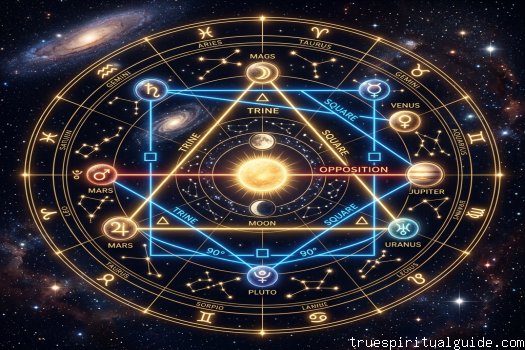
Introduction: The Celestial Conversations
Have you ever looked at a birth chart and felt overwhelmed by the web of red and blue lines crisscrossing the center of the wheel? Those lines are not just decoration; they represent one of the most powerful layers of astrological interpretation: Planetary Aspects. While understanding your signs and houses is crucial, aspects reveal how different parts of your psyche interact with one another. To ground yourself in the basics before diving in, we highly recommend revisiting our guide on understanding your birth chart.
Think of the planets in your chart as different voices within you. The aspects are the conversations taking place between those voices. Some planets speak in perfect harmony, supporting and amplifying each other's strengths. Others clash in intense arguments, creating internal friction that drives you to grow. Let us decode these celestial conversations to see how they shape your personality.
The Geographic Perspective: How Aspects are Calculated
From an astronomical standpoint, an aspect is a geometric angle formed between two planets as viewed from the Earth. Astrology is geocentric, meaning it calculates all celestial coordinates from the physical location of the observer on Earth. The exact horizon and meridian lines at your geographic birth location serve as the reference frames. The angles—measured in degrees along the 360-degree ecliptic circle—determine how these planetary energies interact from our earthly viewpoint. Whether you were born in Los Angeles, California, or London, England, the Earth's orientation at that exact place dictates the precise alignments and aspects between the planets in your natal sky.
The Concept of Orbs of Influence
In a perfect world, aspects would be exact to the degree. For example, a perfect square is exactly 90 degrees. However, astrology allows for a margin of error, known as an "orb." If two planets are 86 degrees apart, they are still considered to be in a square aspect with an orb of 4 degrees. Typically, the closer the aspect is to the exact degree (a smaller orb), the more powerful and noticeable its influence will be in your daily life.
The Five Major (Ptolemaic) Aspects
Developed by the ancient astronomer Ptolemy, these five aspects form the foundation of Western astrology. They are divided into harmonious (easy) and dynamic (challenging) relationships.
1. Conjunction (0°): The Blended Fusion
A conjunction occurs when two or more planets are sitting in the exact same spot in the zodiac (within an orb of 0 to 8 degrees). Their energies fuse together so tightly that they act as a single unit. This creates an intense concentration of power. For example, if you have Mercury conjunct Saturn, your thoughts (Mercury) are deeply colored by discipline, caution, and structure (Saturn). While this gives you immense focus, it can sometimes make it difficult to separate the two energies, leading to mental rigidity.
2. Sextile (60°): The Spark of Opportunity
A sextile is a harmonious aspect that occurs when planets are two signs apart (separated by 60 degrees). The elements involved are always compatible (Fire and Air, or Earth and Water). Sextiles represent talents and opportunities that require a bit of effort to unlock. They are like seeds of potential; if you water them with practice and attention, they will grow into incredible skills. A Venus sextile Mars aspect, for example, gives you a natural charm and social ease that you can easily tap into.
3. Square (90°): The Call to Action
A square is a dynamic, challenging aspect that occurs when planets are three signs apart (separated by 90 degrees). The elements involved conflict with one another, creating intense internal tension and friction. Squares are often feared, but they are actually the engines of personal growth. Without squares, we would lack the drive to overcome obstacles and achieve greatness. A square forces you to act, resolve conflicts, and build resilience. If you have Moon square Pluto, you will experience intense emotional lessons that ultimately lead to deep psychological power.
4. Trine (120°): The Flow of Natural Talent
A trine is the most harmonious and auspicious aspect in astrology. It occurs when planets are four signs apart (separated by 120 degrees), sharing the exact same element (Fire, Earth, Air, or Water). Trines create a smooth, effortless highway of energy. Talents flow so naturally here that you might not even realize you have them because they require no strain. For instance, a Sun trine Jupiter aspect brings natural optimism, luck, and protective energy. The only danger of a trine is complacency; because things come easily, you may take your gifts for granted.
5. Opposition (180°): The Balancing Act
An opposition occurs when two planets sit directly across from one another on the wheel (separated by 180 degrees). This creates a tug-of-war between two contrasting areas of your life, often manifesting as a sense of being pulled in opposite directions. The lesson of an opposition is integration and balance. We often project the energy of one planet onto other people in relationships, learning to balance the polarity through partnerships. A Sun opposite Moon aspect, for example, requires you to find harmony between your conscious desires (Sun) and your subconscious emotional needs (Moon).
Integrating Aspects into Your Chart Reading
When reading your aspects, always start with the planets involved. The personal planets (Sun, Moon, Mercury, Venus, Mars) represent your daily personality. The outer planets (Jupiter, Saturn, Uranus, Neptune, Pluto) represent generational forces and life lessons. When an outer planet aspects a personal planet, it infuses your personality with deep karmic themes. By learning to interpret these connections, you can see how your inner voices interact. To see how these aspects fit into your overall chart structure, head back to our main guide on understanding your birth chart.